

Table of Contents
- Best Durable Hoodies for Outdoor Life: What Actually Lasts
- Quick Comparison: Midweight Hoodies Built for the Trail
- Durable Hiking Hoodies: Fabric Weight, Stitching, and Hardware
- Best Sun Hoodies for Hiking: UPF Coverage Without the Heat
- Outdoor Hoodie Layering Guide: Base Layer to Outer Layer
- Hoodie Fabric Durability and Care: Washing, Pilling, and Lifespan
- Fit, Sizing, and Mobility for Real Trail Days
- Pricing, Value, and Who Each Hoodie Is For
- Frequently Asked Questions
Last Updated: October 14, 2026
Best Durable Hoodies for Outdoor Life: What Actually Lasts
A durable hoodie for outdoor life holds its shape, color, and stitching through repeated washing, layering, and abrasion against pack straps and branches. At Tortoise Trail Gifts, we build our hoodies around that idea: midweight fabric, reinforced construction, and designs that hold up season after season.
Most shoppers compare hoodies on looks alone. That is the mistake. A hoodie that pills after three washes or loses its cuff elasticity by fall is not a bargain at any price.
Quick Comparison: Midweight Hoodies Built for the Trail
Every hoodie in our lineup is a midweight, unisex pullover at $45.99, so the difference comes down to design and use case.
| Hoodie | Design Focus | Best For | Price |
|---|---|---|---|
| Trail Tested, Faith Approved | Mountain-and-forest back print, chest patch | Trailheads and campfire wear | $45.99 |
| Miles Measured in Memories | Vintage camper back graphic | Road trips and campsite mornings | $45.99 |
| New Mercies, New Trails | Vintage mountain design | Early walks and chilly trailheads | $45.99 |
| God's Pace, Not the World's Race | Sunrise-over-cabin scene | Slow mornings and small group | $45.99 |
| Not Lost, Just Guided | Mountains-and-cross poster back | Quiet trail mornings | $45.99 |
| His Paths Are Higher | Painterly mountain sunrise | Chilly trailheads and bonfires | $45.99 |
| God's Second Calling | Scenic faith design | Retirement gifts and church retreats | $45.99 |
The short version: if you want one hoodie for general outdoor wear, the Trail Tested, Faith Approved Hoodie is our pick. If you are buying for someone else, the God's Second Calling Hoodie works as a retirement or milestone gift.

Durable Hiking Hoodies: Fabric Weight, Stitching, and Hardware
Durable hiking hoodies are built from midweight fabric with reinforced seams and hardware that resists repeat wear. Midweight sits between a light summer layer and a heavy winter fleece, which is why it works across three seasons in most conditions.
Fabric Weight and Warmth Without Bulk
Fabric weight is measured in grams per square meter (GSM), and it determines both warmth and how the hoodie layers:
- Lightweight (roughly 150-200 GSM): summer sun layers and travel hoodies; dries fast, offers little insulation.
- Midweight (roughly 250-350 GSM): the three-season sweet spot for hiking, camping, and everyday outdoor wear.
- Heavyweight (roughly 400 GSM and up): cold-weather work and stationary use; warm but slow to dry and bulky under a shell.
A midweight hoodie traps warmth without the bulk that makes a heavy fleece awkward under a shell.
Heavier is not automatically better. A heavyweight hoodie can feel stiff and slow to dry, while a light one loses shape faster under abrasion. Midweight is the practical middle ground for most trail use.
Seams, Cuffs, and Zippers That Survive Repeat Wear
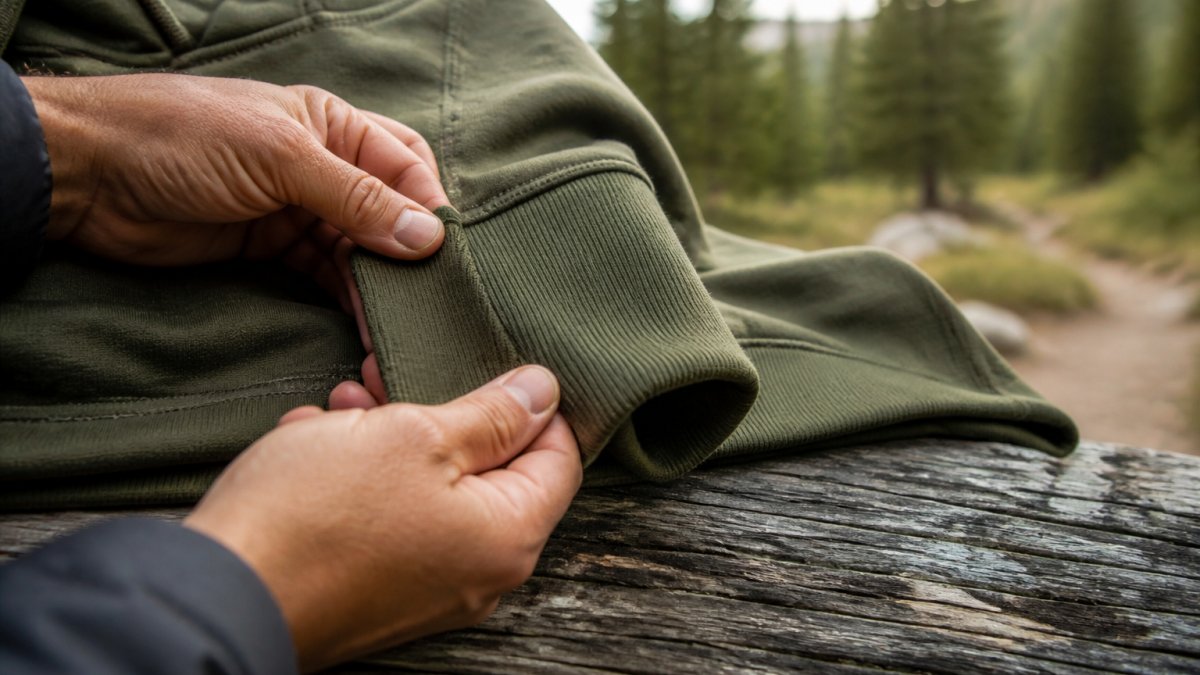
Reinforced stitching at stress points is the clearest durability signal on any hoodie. Stress points are the shoulders, neckline, cuffs, and hem, which take the most pull every time you put the garment on or take it off.
What most guides miss is the cuff: one that loses elasticity turns a good hoodie into a shapeless one. Check that the ribbing feels dense and springs back when stretched.
How to Judge Durability Before You Buy
Instead of trusting a general "built to last" claim, run the same checks a gear tester would:
- Abrasion resistance: rub the fabric firmly against a rough surface (a concrete step or a pack strap) about 20 times. A durable knit shows minimal fuzz; a weak one starts to pill immediately.
- Seam strength: grip the fabric on both sides of a shoulder seam and pull gently. Stitching should hold without gaps or visible thread strain. Look for flatlock or double-needle stitching at high-stress seams rather than a single row.
- Pilling tendency: check the underarm and side panels, where friction is highest. If those areas already look fuzzy on a new garment, expect faster wear.
Hoodies typically fail in this order: cuffs lose stretch, then pilling appears at friction points, then shoulder seams start to gap. Inspect those three areas first and you can predict most of a hoodie's working life.
How Fabric Performs Across Outdoor Conditions
A rugged sweatshirt and a technical sun layer are not the same tool:
- Wind: a tight knit with a higher GSM blocks more wind; a loose, airy knit lets it through. A hoodie is not a windshell, so plan on a shell for exposed ridges.
- Light rain: cotton blends soak and stay heavy; synthetics and wool blends shed light moisture and dry faster. None of these replace a waterproof shell.
- Cold: midweight knit insulation works best as a mid layer, where trapped air does the warming.
Match the fabric to the condition you face most often: midweight covers shoulder seasons, lighter handles peak summer, and heavier is for cold, low-output use.
Best Sun Hoodies for Hiking: UPF Coverage Without the Heat
The best sun hoodies for hiking use a lighter fabric and a looser cut to keep you covered without overheating.
For hot-weather hiking, prioritize breathability and quick-drying fabric over warmth. Light colors reflect heat; dark colors absorb it. A sun-protection hoodie should feel airy, not clingy.
Layering logic flips here: in cool weather a hoodie is insulation, in strong sun it is a shield, and you want the lightest version that still blocks exposure.
Outdoor Hoodie Layering Guide: Base Layer to Outer Layer
An outdoor hoodie layering guide starts with one rule: the hoodie is a mid layer, not a base layer.
Here is how we would build a three-season system:
- Base layer: a moisture-wicking tee or light long sleeve against the skin
- Mid layer: your hoodie, worn over the base layer for warmth
- Outer layer: a windproof or waterproof shell when conditions turn
On mild days, the hoodie works alone; on cold days, it disappears under a shell. A midweight hoodie adds warmth without so much bulk that your shell stops fitting properly.
Sizing matters: a hoodie cut too tight restricts movement under a shell, while one cut too loose lets cold air pool.
Trail Tested, Faith Approved Hoodie – Christian Mountain Sweatshirt, Unisex →
Hoodie Fabric Durability and Care: Washing, Pilling, and Lifespan
Hoodie fabric durability and care come down to washing habits more than fabric type. Most premature wear happens in the laundry, not on the trail, and this is where you can add years to a hoodie's working life.
A Wash Routine That Protects the Fabric
- Wash cold to reduce shrinkage and color fade
- Turn the hoodie inside out to protect the print from abrasion
- Skip fabric softener, which coats fibers and reduces breathability
Pilling: What Causes It and How to Slow It
Pilling is the most visible sign of wear: loose fibers tangle on the surface, usually from friction against pack straps or washing with rougher fabrics. Slow it by washing inside out and avoiding high heat. A fabric shaver or fine sweater comb removes existing pills without cutting into the knit; do not pull them off by hand, which drags more fibers loose.
Repair Before You Replace
Small fixes are the difference between a two-season hoodie and a five-season one:
- Loose seam: stitch it with a matching thread before it becomes a hole. A simple backstitch or a few whip stitches holds a shoulder or hem seam.
- Snagged thread: trim it with sharp scissors rather than pulling, which distorts the knit.
- Lost cuff elasticity: a tailor can replace ribbed cuffs and a hem band for far less than a new hoodie.
Realistic Lifespan Expectations
There is no single number, but a common pattern for a midweight hoodie worn regularly outdoors:
- 1-2 years: cuffs may start to relax and pilling appears at friction points if care is rough.
- 3-5 years: with cold washing, air drying, and prompt repairs, the body and seams often hold up well; cuffs and hem are the first parts to need attention.
- Beyond 5 years: expect visible fading and some thinning at high-wear areas, even with good care.
Treat those as ranges, not guarantees. Heavier use, abrasive pack straps, and frequent hot drying all shorten the timeline. Tracking how a hoodie looks after each season tells you more than any label claim.
Sustainability and Repairability Trade-Offs
Longevity is the most practical form of sustainability: a hoodie worn five years uses fewer resources than three worn two years each. When comparing options, weigh:
- Recycled content: recycled polyester reduces demand for new plastic, but it still sheds microfibers in the wash. A microfiber-catching wash bag helps.
- Natural fibers: cotton and wool biodegrade and feel good against the skin, but cotton holds moisture and wool needs gentler care.
- Blends: cotton-poly mixes often balance comfort, cost, and shape retention better than either fiber alone.
A hoodie you can repair and that holds its shape for years beats a cheaper one you replace every season, both for your wallet and for the materials it takes to make it.
Fit, Sizing, and Mobility for Real Trail Days
Fit, sizing, and mobility determine whether a hoodie works on a real trail day or just looks good in a photo.
Our hoodies are unisex, designed to work across body types rather than tailored to one.
Mobility checks worth doing before you commit:
- Raise both arms overhead and see if the hem lifts past your waistband
- Reach across your body and check for pull across the back
- Put on your pack and confirm the straps do not dig into the shoulder seams
Hood coverage is the other fit factor people overlook: a hood that stays put in wind beats one that flaps, and cuffs and hem should sit snug without cutting off circulation.
Pricing, Value, and Who Each Hoodie Is For
Every hoodie in our lineup is $45.99, which puts the decision on design and use case rather than cost.
Here is who each one suits:
- Trail Tested, Faith Approved: the all-rounder, best for trailheads and campfire evenings
- Miles Measured in Memories: for road trips, campsite coffee, and RV life
- New Mercies, New Trails: for early risers and quiet morning walks
If you are unsure of a size for a gift, our unisex cut and standard sizing make it easier to get right than a fitted brand would.

Picking a hoodie that survives real outdoor use is less about brand names and more about fabric weight, seam construction, and care.
Frequently Asked Questions
What makes a hoodie durable enough for outdoor use?
Durability comes down to three things: fabric weight, construction, and hardware. A midweight cotton or cotton-blend fleece holds its shape better than thin jersey. Reinforced stitching at stress points, plus ribbed cuffs and hem, keeps the hoodie from stretching out. Metal or high-quality plastic zippers outlast cheap coil pulls. Wash durability matters too: a hoodie that pills or shrinks after five washes is not durable, no matter how it feels in the store.
What fabric is best for a durable outdoor hoodie?
Cotton-polyester blends offer the best balance for casual trail use. Cotton breathes and feels soft against the skin, while polyester adds abrasion resistance and helps the hoodie hold its shape through repeated washing. Midweight fleece and French terry are common choices because they resist pilling better than lightweight knits. Merino wool works well as a base layer but costs more and needs gentler care. For most hikers, a midweight blend is the practical pick.
Are cotton hoodies good for hiking?
Cotton hoodies work fine for cool, dry conditions, casual walks, and camp evenings. The problem is moisture: cotton absorbs sweat and rain, dries slowly, and loses insulation when wet. For high-output hiking or wet weather, a synthetic or merino base layer under a cotton hoodie gives you the comfort of cotton with better moisture management. If your hikes are short and the weather is mild, a cotton-blend hoodie is a reasonable choice.
How should an outdoor hoodie fit as a layering piece?
A layering hoodie should fit close enough to trap warmth but loose enough to slide over a base layer without bunching. Check that you can raise your arms overhead without the hem riding up past your waist. Sleeves should reach your wrist bone without covering your hands. If you plan to wear it under a shell, size so the hoodie does not add bulk at the shoulders. Mobility matters more than a snug silhouette on the trail.
How do you wash a hoodie so it lasts longer?
Turn the hoodie inside out, wash in cold water on a gentle cycle, and skip the fabric softener, which coats fibers and reduces breathability. Tumble dry on low or hang dry to minimize shrinkage and pilling. If the hoodie has a printed graphic, avoid high heat, which can crack the print over time. Washing less often and spot-cleaning between wears also extends fabric life. Following the care label is the simplest way to protect your investment.
0 comments